

Cooking Rajma Three Ways
A collaborative study on comfort, cooking methods, and the kitchens we build around them


Rajma is one of North India’s great comfort dishes, and in this post we compare three ways of cooking it: pressure cooker, Instant Pot, and a slower stovetop to oven method.
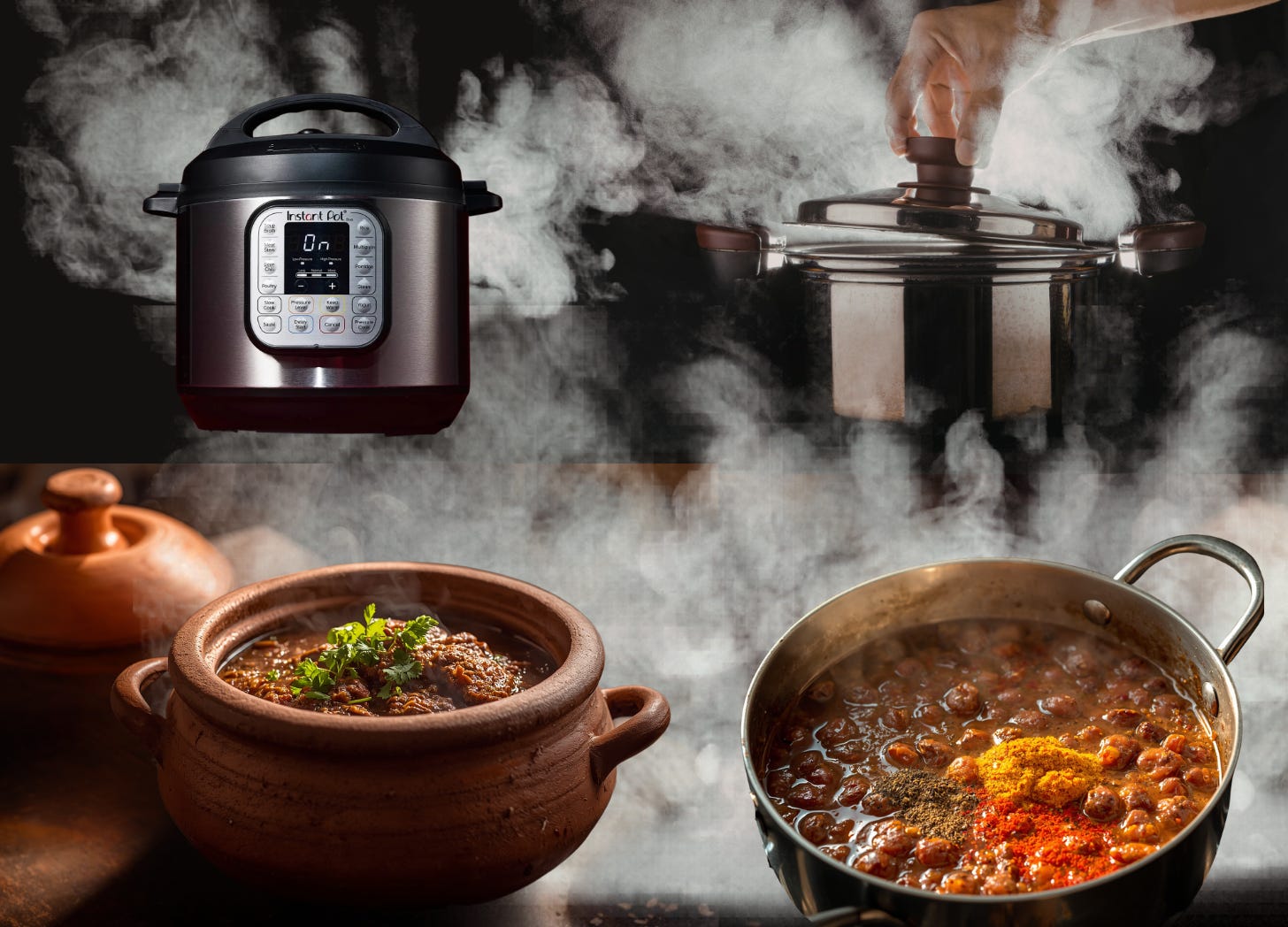
This collaboration began very naturally. A post by Annada D. Rathi on pressure cookers opened into wider conversations among the three of us about legumes, fuel, texture, cooking time, bean varieties, and the curious emotional loyalty people develop toward particular kitchen tools. Then somehow, we arrived at rajma, which makes perfect sense, because few dishes sit so comfortably at the meeting point of practicality, memory, and everyday comfort in the Indian culinary heartbeat.
Rajma is the kind of dish that belongs to ordinary life. It is not dependent on ceremony or restaurant flourish, although it can. It lives in weekday cooking, in family kitchens, in pressure cookers, in modern electric appliances, in pots set to simmer while rice cooks beside them, and in the quiet relief of sitting down to something deeply familiar after a long day. For this project, we decided to compare the dish across three cooking approaches: the classic Indian pressure cooker, the Instant Pot, and the slower route of stovetop cooking, with one of my versions also finished in the oven. What interested us was not simply which method might be called best, but how each one shaped the final pot.
What quickly became clear is that rajma is not a single, fixed idea. The bean itself varies across regions, with different rajma types offering different textures, flavours, and cooking qualities. Some are small and creamy, some denser and more robust, and some especially prized for their softness or earthy depth. That regional variation matters, and so does the age of the bean, the soaking time, and the way the heat is applied. All of these shape the final dish as much as the recipe does.
What also became clear is that the method changes the route, but not the emotional purpose. The pressure cooker offers speed and fuel efficiency. The Instant Pot brings consistency and ease to many contemporary kitchens. The stovetop allows slower layering and more gradual flavour development, and in my own kitchen I sometimes extend that process into the oven for an even deeper finish. Yet all three versions still arrived recognisably as rajma: generous, sustaining, and deeply comforting.
A Bean That Crossed Oceans
Rajma feels so deeply woven into North Indian food culture that it is easy to forget it was once entirely foreign to the subcontinent. Kidney beans originated in Central and South America and most likely entered India around the 16th century through Portuguese trade routes during the Columbian Exchange. Over time, the bean adapted especially well to the cooler climates of northern India, particularly in the Himalayan belt, where smaller and often more flavourful regional types became established. Jammu, Himachal Pradesh, Uttarakhand, Kashmir, Punjab, Rajasthan, and parts of the Northeast all developed their own rajma traditions, helping turn an imported bean into one of the most beloved comfort foods in North Indian cooking.
Today, rajma sits in mountain homes, city flats, pressure cooker kitchens, Instant Pot kitchens, student kitchens, migrant kitchens, and family kitchens across the world. A bean that travelled a very long way became deeply Indian, and perhaps that is part of why it lends itself so well to a collaboration like this one. Rajma already contains within it a history of adaptation as it spread across the world with the Indian diaspora and travelers returning home with culinary travel dreams.

Types of Rajma in India
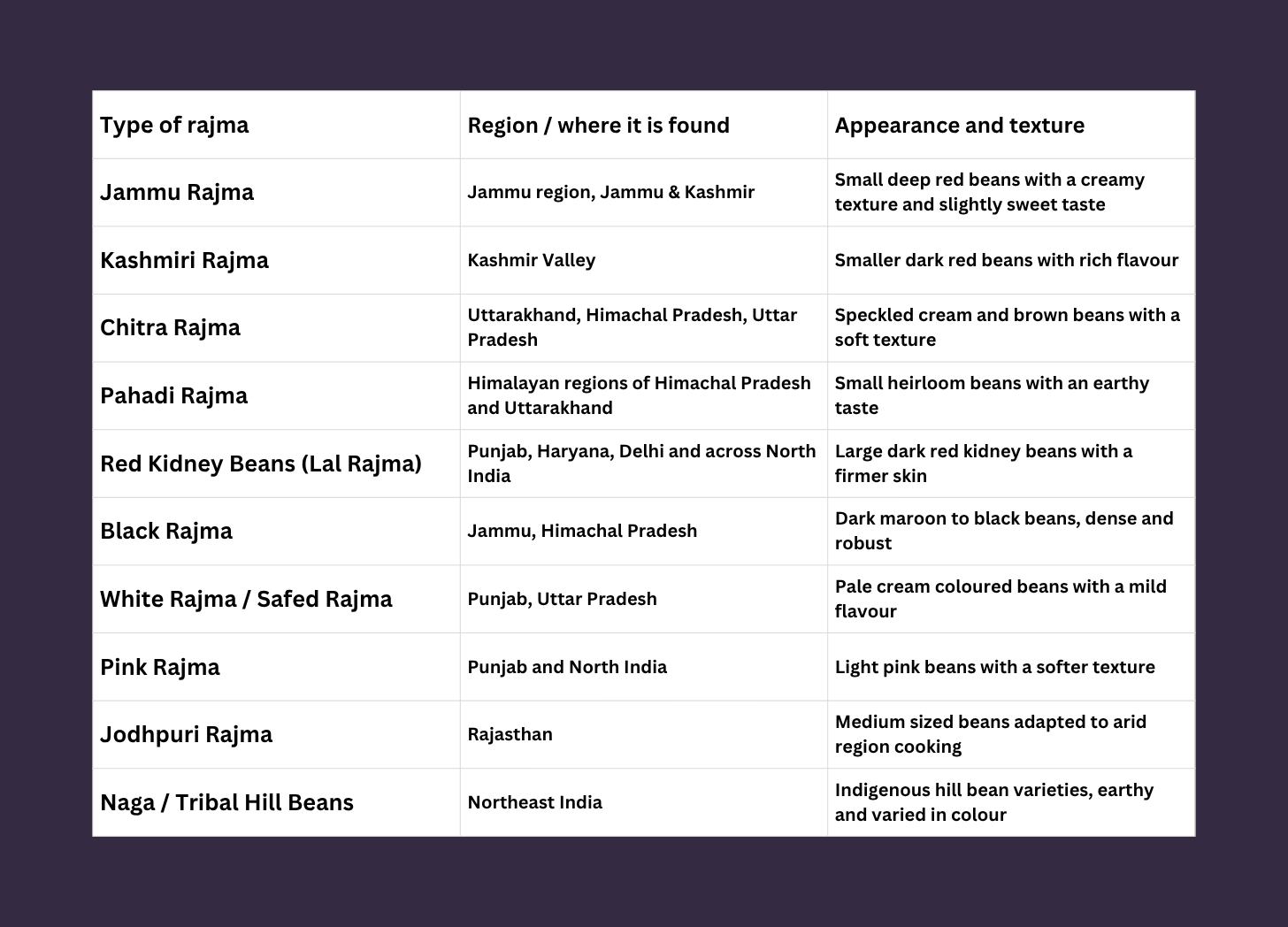
Rajma is often spoken of as though it were one single bean, but in practice it is a family of regional types with different sizes, colours, textures, and cooking qualities. Some are small and creamy, some are dense and robust, and others are prized for their softness, sweetness, or earthy depth. The chart below gives a simple overview of some of the main rajma types found across India and the regions with which they are associated.
Table 1. Types of Rajma in India: regions, appearance and texture
The Cooks Behind the Pots

Annada D. Rathi — Pressure Cooker Method
Everyday Indian cooking, practicality, and the flavour memory of home
I have had the pleasure of collaborating with Annada D. Rathi before, first on our Curry Night post and more recently in our Green Mango Cook-Off, so it has been a joy to cook alongside her again here. Annada writes the Substack ChutneyLovers, which suits her perfectly because she truly does love chutney in all its forms. Raised in India and living in the United States for many years now, she writes about Indian food with warmth, intelligence, and a close understanding of everyday kitchen realities. Her work is attentive to labour, flavour, fuel, practicality, and memory, and she has a gift for making Indian food approachable without thinning out its depth. It was, in fact, her writing on pressure cookers and energy use that helped spark this whole collaboration.

Harshita Saxena — Instant Pot Method
Memory, culinary heritage, and adapting comfort to contemporary kitchens
Harshita saxena brings another important perspective to this collaboration. Raised in Bhopal and now living in the UK, she writes about food as memory, inheritance, and cultural continuity. Her work is deeply attentive to the emotional life of the kitchen and to the ways recipes carry family, place, and feminine lineage forward through time. Through her Substack Epicurean Dispatch and her catering work, she preserves culinary heritage not as something static, but as something living and adaptive. That makes her a particularly thoughtful voice for the Instant Pot method, which reflects the realities of many contemporary kitchens while still holding on to the comfort and significance of traditional food.

Lisa McLean — Stovetop and Oven Method
Slow cooking, flavour development, and layered heat
My own approach to rajma in this collaboration comes from the stovetop and from the slower arc of oven cooking. I was interested in what happens when you give the pot more time, allowing the beans and masala to settle into one another gradually. My work often moves between storytelling, kitchen practice, nutrition, and food science, and beans are one of those ingredients that reward exactly that kind of attention. On Culinary Repertoire, I write across recipes, spice traditions, and Science Corner essays, where evidence, tradition, and kitchen practice meet. In this collaboration, I am bringing the slower heat, the layering of flavour, and the textures that emerge when time is given room to work.
The Three Cooking Methods
The Pressure Cooker
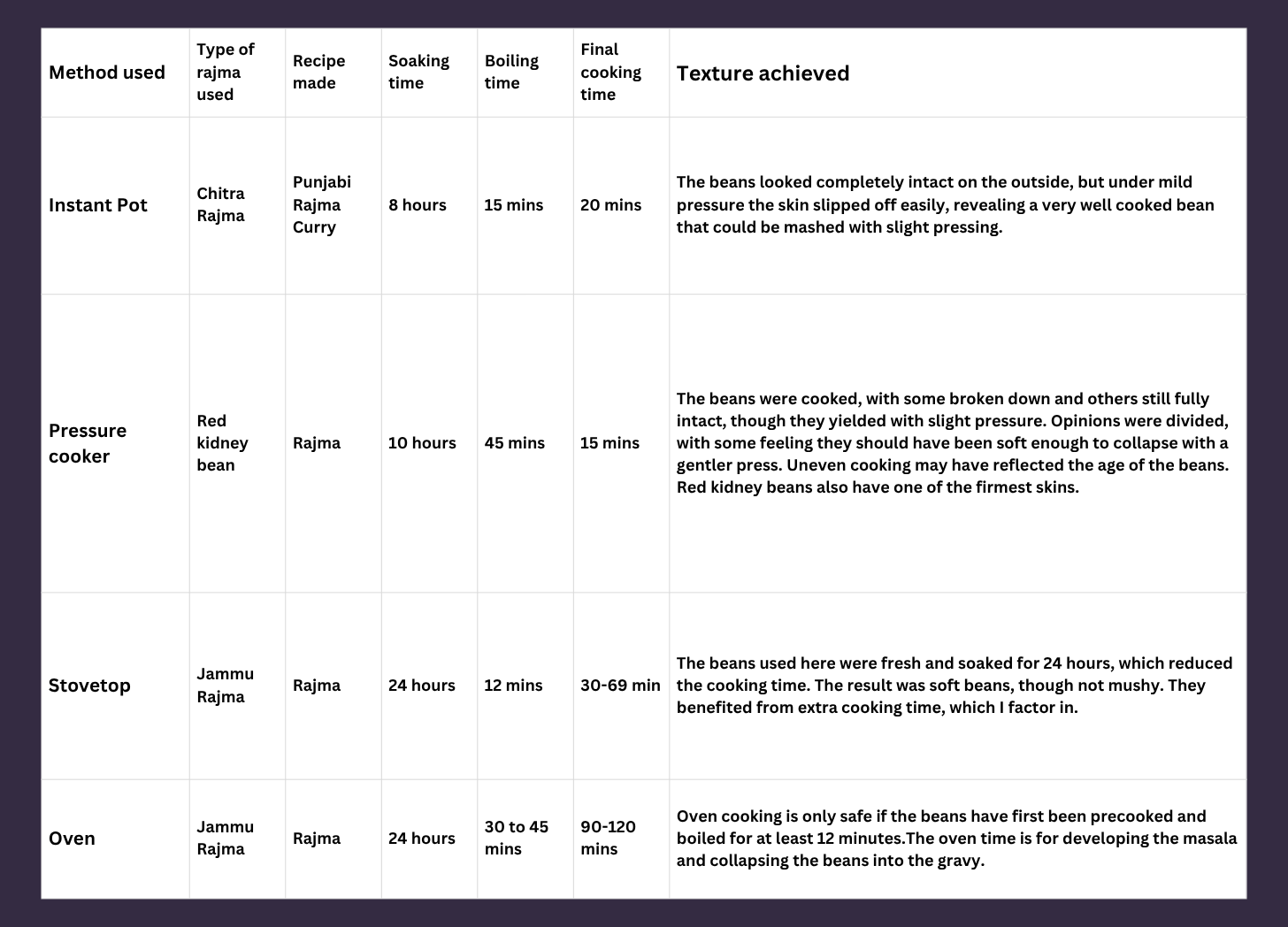
For Annada, the pressure cooker is not simply a tool. It belongs to the deep structure of the modern Indian kitchen, where fuel use, time, practicality, and texture all matter. The pressure cooker offers speed and efficiency, but it also produces the kind of creamy, cohesive bean texture many cooks want in rajma. In her test cook, the red kidney beans were cooked, though not perfectly evenly, with some breaking down more than others. She notes that the age of the beans likely contributed to that unevenness, and also points out that red kidney beans have one of the firmest skins.
The Instant Pot
Harshita’s Instant Pot version reflects the realities of many contemporary kitchens, especially those balancing comfort cooking with work, energy use, and limited time. In the test cook, the Chitra Rajma appeared completely intact on the outside, but beneath the surface the beans were very well cooked and easily mashed with light pressure. That result speaks to one of the Instant Pot’s strengths: a reliable internal creaminess with comparatively little hands-on cooking.
The Stovetop and Oven
My own version follows a slower path. I used Jammu Rajma, soaked for 24 hours. The fresh beans cooked more quickly because of that long soak, and the stovetop version gave soft beans that were tender but not mushy. I also worked with a stovetop-to-oven method, where the rajma is first properly boiled, then finished in the oven for a further hour. This slower route is less about speed and more about flavour development, allowing the beans and masala to settle into one another over time. It is important to note that oven cooking is only safe once the beans have already been properly precooked and boiled for at least 12 minutes beforehand.

Annada D. Rathi — Pressure Cooker Method
Everyday Indian cooking, practicality, and the flavour memory of home
I love my two PCs. I have them in my daily rotation so cooking beans in a PC feels super organic to my culinary process and style. On one hand, it gives me satisfaction that I am not wasting cooking gas and on the other I don’t have to go through the discomfort of hauling a bulky device from my bottom shelf to the counter.
Have you seen my post from last week with the recipe of rajma or rajma masala? A precursor to this joint article, this post contained my recipe adapted from Chef Sanjyot Keer, YFL. One of the original recipe’s highlights was the ratio of 3 times water to 1-part dry kidney beans. And after pressure cooking, this bean-to-water proportion ensured a silky, velvety sauce, perfect to coat rice or paratha, your carb of choice.
As long as you know the amount of water/broth/liquid to add, the resulting consistency of the dish is highly desirable. For example, the pressure-cooked khichdi is a thing of beauty because the ultimate consistency is creamy and cohesive and makes you feel secure like in the honeymoon period of a relationship.
I couldn’t be happier to collaborate with Lisa and Harshita. Both are supremely passionate about their work and willing to research a topic to the end of the world. Apart from the breadth of global culinary knowledge that Lisa covers in her posts, the science corner is the absolute killer.


Harshita saxena Instant Pot Method
Memory, culinary heritage, and adapting comfort to contemporary kitchens
My Instant Pot version reflects the realities of many contemporary kitchens, especially those balancing comfort cooking with work, energy use, and limited time. In the test cook, the Chitra Rajma appeared completely intact on the outside, but beneath the surface, the beans were very well-cooked and easily mashed with light pressure. That result speaks to one of the Instant Pot’s strengths: a reliably creamy interior with comparatively little hands-on cooking.
I have been using the Instant Pot for over five years now, and honestly, it has become one of the most practical tools in my kitchen.
For dishes like rajma, it creates beautifully creamy beans with very little active supervision while keeping the cooking process consistent and efficient. Rajma can often be unpredictable, but the Instant Pot makes it far easier to manage on busy days without losing the comforting texture and flavour that make the dish special.
I also think many people get intimidated by the appliance because they assume they must always wait for the pressure to release naturally. But that is part of the Instant Pot’s convenience. Once the buzzer goes off, you can carefully release the steam manually and move straight to the next stage of cooking.
As someone balancing work, writing, research, and everyday life, I genuinely find that practicality appealing.
I do not see the Instant Pot as a replacement for traditional cooking. I see it as another chapter in the long history of Indian kitchens adapting intelligently to changing lives.


Lisa McLean Stovetop and Oven Method
Slow cooking, flavour development, and layered heat
My own rajma followed the slower path, which is perhaps not surprising. I began on the stovetop and, in one version, carried the pot through into the oven. I used Jammu rajma, soaked for 24 hours, and because the beans were fresh they cooked more quickly than older beans often do. Even so, I was not looking for the kind of bean that collapses at the slightest touch. I wanted tenderness with some integrity still left in it, beans soft enough to take in the masala and return some of themselves to the sauce, but not lose all shape.
What I love about stovetop cooking is that it keeps you in conversation with the pot. You can see when the onions have softened enough, when the ginger and garlic have lost their rawness, when the tomatoes begin to melt into the spices, and when the liquid needs adjusting. It is a slower method, but it gives you the chance to respond as the dish develops rather than handing the whole job over at once.
Taking the rajma into the oven extends that same idea. Once the beans have been properly precooked and boiled safely, the oven gives a gentler, more surrounding heat. The masala thickens, the flavours settle, and the whole dish becomes deeper, rounder, and more luxurious. It is the version I would choose on a weekend, when I have time to let the pot unfold slowly.
This method suits the way I tend to cook more generally. I often prepare legumes on the weekend to have on hand through the week, so a slower rajma feels like a pleasure rather than a burden. For me, this version is about flavour development, texture, and the quiet rewards of giving a dish enough time.
Rajma Chawal, Two Ways

Rajma chawal is one of the most comforting ways to cook kidney beans, and in this post I am sharing two versions I make at home: a richer stovetop and oven rajma for weekends, and a simpler stovetop …

What We Observed
The comparison made one thing very plain: cooking method matters, but it is never the only variable. The bean variety matters, as does the soaking time, and the age of the bean and the firmness of the skin. Even within one method, those things can alter the final result significantly. Our observations suggest that it makes more sense to think in terms of trade-offs than winners. One method may be more efficient, another may be more forgiving, whilst a third may offer more gradual flavour development. But all of them can lead to a successful and deeply satisfying pot of rajma when the cook understands the beans in front of them.
Table 2. Comparative cooking results for rajma across four methods

I’ve done a deep dive into the science behind kidney beans and cooking methods, so you can have a read if this appeals to you.
Kidney Bean Science Corner

This post takes a closer look at kidney beans, from its nutritional and functional compounds to its place in the kitchen. Science Corner is where I bring together evidence, traditional knowledge, and the everyday practice of cooking. My perspective is shaped by a life spent between clinic work, research, and the stove, and I hope to make these ideas cle…
How to Prepare Kidney Beans Safely and Well

This Science Corner companion post looks closely at the preparation of kidney beans: why they must be cooked properly, what soaking does, how heat changes the bean from within, and why different cooking methods produce different results. It is designed to sit beside the broader Kidney Bean Science Corner as a more detailed guide to the science and pract…
This whole process has shown that there is more than one way to cook a delicious pot of rajma. Whatever cooking method we prefer, it comes with considerations about the beans themselves: how long it has been since they left the vine, how long they have been soaked to rehydrate, and the approach we take to cooking them. Even the cook, the kitchen, and the life around the pot play their part. If we cook rajma with love and patience, it shows on the palate, and in the comfort, pleasure, and nourishment we receive from it, no matter which method we choose. Pressure cooker, Instant Pot, stovetop, or stovetop and oven, each route shaped the dish differently, yet all of them arrived at the same essential place: a bowl of food that comforts, nourishes, and feels like home. We each came to this pot with different tools, habits, and instincts, and it was a pleasure to see how much could be learned by cooking alongside one another in this global rajma conversation.

©Lisa McLean 2026
All photography on Culinary Repertoire ©Lisa McLean 2026
 | A guest post by
|
 | A guest post by
|
I am with you on the stove top for deep slow mindful cooking. I don’t have either of these other gadgets in this kitchen. We are terribly simple here. I bet your Rajma was even better the next day. I have not had it before but my daughter recognized it and promises to make it one day. On the stove top. I told her about finishing in the oven and she likes that idea.
I also loved the format here - you have put a lot of work into this post Lisa - and it shows! Beautiful layout.
I always jump to the science of course!!
Love this experimentation! I have never heard of Rajma before and really enjoyed your charts with all the different varieties. This is going in my list to try!